

The Leadership Vacuum: Why You Can’t Delegate Marketing Strategy Downward
Why Your B2B Company Needs a Fractional CMO (And How to Know If You’re Already Paying the Price)
You’re spending 7–10% of revenue on marketing. Yet if I asked you right now what ROI you’re getting from that spend, could you answer with confidence?
If you hesitated, you’re not alone. And more importantly, you’re not failing. The problem isn’t your effort or your team’s effort—it’s structural. Most $5M–$50M B2B companies have a leadership vacuum at the top of their marketing function. And when no one owns the strategy, the entire system defaults to tactics.
Let me explain what this costs you, why it’s happening, and what a better model looks like.
The Leadership Vacuum: What Happens When Strategy Has No Owner
Here’s the typical pattern I see when I talk to CEOs and presidents of mid-market B2B companies:
First, you hire a marketing coordinator or manager. They’re sharp, eager, and affordable. You tell them to “own marketing,” and they nod and get to work. Next, you bring in an agency or two to handle what they can’t—video production, content strategy, media buying. The relationship feels transactional: you brief them, they execute, you approve and pay.
Meanwhile, you retain all the strategic decisions. Because marketing affects your brand and you care deeply about it, you stay involved. You approve copy, weigh in on which channels to test, and sometimes override decisions based on a hunch or something you heard at a conference.
The result? Nobody actually owns the growth strategy.
Your coordinator feels responsible but has no absolute authority. Your agency executes without a strategic context—they don’t know your longer-term bets or your customer economics. And you feel accountable but lack visibility into whether marketing is actually moving the needle on growth.
Nobody on the team can step back and ask: “Are we pursuing the right markets? Are we testing the right messages? Are we allocating money in a way that maximizes revenue per dollar?”
These aren’t questions a coordinator can answer. They require data analysis, cross-functional context, and executive authority.
What This Looks Like in Practice: The Goelzer Story
When I stepped in as fractional CMO for Goelzer Industries—a 38-year-old manufacturing company operating at 40–50% capacity—this is precisely what I found. They’d never run a formal marketing campaign. They relied entirely on referrals inside a shrinking ecosystem. Digital alternatives were eroding demand, and 8–9 direct competitors were actively shutting down.
They were working hard. But they were stuck in what the industry calls “random acts of marketing”—disconnected tactics executed without a unifying strategy.
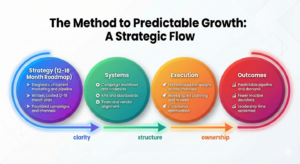
Within my first 90 days, I did something that felt risky at the time: I committed them to a fully written, costed 12–18 month strategic marketing plan. Not a collection of campaigns. A plan. One that tied every dollar and every hour of effort to a clear growth hypothesis.
Had that strategy been wrong, it would have accelerated their decline with no fallback. But that’s the difference between having a senior marketing leader and not having one. Someone has to take accountability for the whole system working—not just individual campaigns.
Within 12 months, Goelzer doubled its client base, generated consistent inbound leads, and re-established itself as a recognized industry leader. While their competitors failed, they thrived.
Not because they suddenly had better tactics. Because they finally had a strategy.
The Hidden Cost of Random Acts of Marketing
Let’s be concrete about what happens when you have this leadership vacuum.
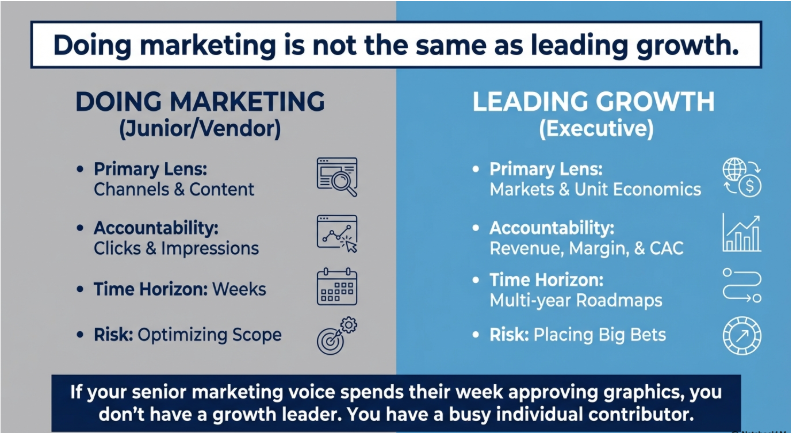
Your growth slows. Companies with strong CEO–marketing alignment—where the marketing leader is deeply involved in strategy and sits close to the P&L—are 1.4 to 2.3 times more likely to achieve above-average revenue growth. Without that alignment, companies plateau.
Your metrics don’t map to reality. CEOs evaluate marketing on revenue and margin. Most junior marketers optimize for tactic-level KPIs: clicks, impressions, leads, and email open rates. These don’t translate to revenue. So, you end up celebrating a campaign that generated 500 leads while having no idea if those leads are any good, whether they’re moving through the funnel, or whether the customer acquisition cost makes sense.
Your marketing spend becomes a black box. Marketing typically represents 5–15% of revenue—often one of your largest P&L line items. Without a senior-led operating model for measurement and reallocation, you’re likely leaving 20–40% of productivity on the table due to poor allocation, channel overlap, and a lack of strategic sequencing.
If you’re spending $500K–$5M annually on marketing and your return is opaque, the cost of not having a senior owner isn’t measured in hundreds of thousands. It’s measured in millions of foregone growth.
The Core Problem: You Can’t Delegate Strategy Downward
Here’s a leadership principle that applies well beyond marketing: You can delegate tasks. You cannot delegate accountability without also delegating authority and context.
When you ask your junior marketing hire to “own pipeline growth,” but they can’t control positioning, pricing, or sales process—and they can’t tell product to deprioritize a feature that’s hurting competitive positioning—you’ve given them responsibility without power.
Meanwhile, you retain accountability for revenue, but you lack visibility into what marketing is doing and why. You have accountability without context.
The result is predictable: your marketing person gets defensive, you get frustrated, and marketing becomes a place where problems get blamed rather than solved.
This is why nearly three-quarters of marketing organizations are stuck in this tactical, reactive state. And it’s why those organizations require more investment while delivering less return.
The Solution: Fractional CMO as the Right-Sized Growth Engine
Here’s the honest reality: hiring a $600K+ full-time CMO doesn’t pencil out for most $5M–$50M companies.
Full-time CMO economics:
- Salary + bonus: $250K–$450K+
- Benefits and overhead: 25–30%
- Total annual cost: $400K–$650K
- Time to hire: 4–6 months
- Time to ramp: 6–9 months before full effectiveness
- Turnover risk: Average CMO tenure is 2–4 years
You’re looking at an annual commitment of $500K+ plus 12+ months of onboarding before they’re fully productive. For a company with a $1–5M marketing budget, that’s disproportionate.
Fractional CMO model:
- Cost: $6K–$15K per month (50–67% savings vs. full-time)
- Flexibility: Contracts of 3–12 months with 30–60 day termination clauses
- Speed to value: 30–45 days to deliver strategic clarity and early wins
The fractional CMO model was built precisely for your situation: companies complex enough to need senior growth leadership but not yet at scale to justify a full-time executive hire.
The pattern is consistent across industries. Once a senior leader owns the integrated growth narrative, execution becomes dramatically more effective across the board.
At Goelzer, we didn’t just run better campaigns. We rebuilt their brand positioning, built proactive demand-generation systems, diversified their marketing channels, and established industry visibility. That transformation happened because someone finally owned the strategic direction—and took accountability for making sure the pieces fit together.
How to Know If You Have a Leadership Vacuum
Do any of these sound familiar?
- Your marketing team is busy, but you can’t explain what ROI they’re driving
- You jump from channel to channel based on what you heard at a conference
- Your marketing calendar is driven by requests from sales, product, or leadership—not a coherent plan
- No single person can explain your marketing hypothesis or how all your activities fit together
- Your marketing KPIs are disconnected from your revenue and margin goals
If three or more of these resonate, you likely have a leadership gap.
What Good Leadership Looks Like
When you have the right senior marketing voice in place—whether full-time or fractional—here’s what changes:
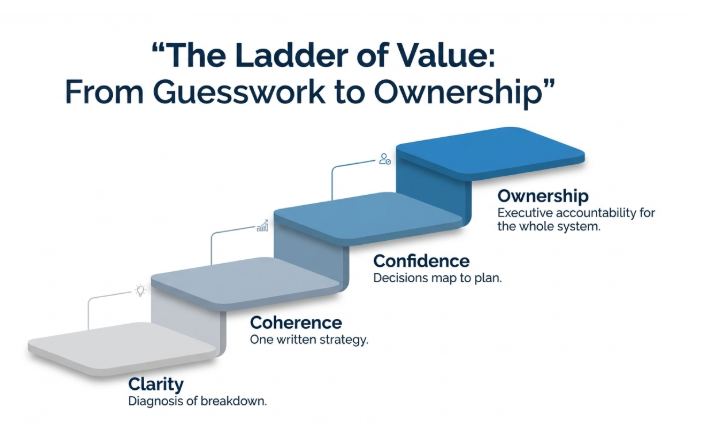
You have clarity. Someone can articulate, in one coherent paragraph, what your growth hypothesis is for the next 12–18 months and how marketing is contributing to it.
You have coherence. Marketing dollars are allocated based on a documented growth thesis, not a collection of requests from across the organization.
You have confidence. The team stops guessing. Decisions map to a known plan.
You have ownership. An executive-level leader is accountable for the whole system working—not just individual campaigns.
This is what we built at Goelzer. And this is what I help $5M–$50M B2B companies build when they’re tired of random acts of marketing and ready for strategic growth.
The Real Question
If you lost your head of marketing tomorrow, would someone internally be able to pick up the thread of your growth strategy and continue executing it?
If the answer is “no,” you don’t have a marketing problem. You have a leadership problem.
The good news? This is fixable. And for most mid-market B2B companies, a fractional CMO model is a pragmatic, cost-effective way to install the senior leadership you need without overcommitting to a full-time executive hire before you’re ready.
If you think your marketing has a leadership gap, the first step isn’t to hire more people or switch agencies. It’s to diagnose.
Let’s talk through what that might look like for your business. No obligation—just a conversation to help you figure out whether a leadership gap is what’s really holding your growth back.